
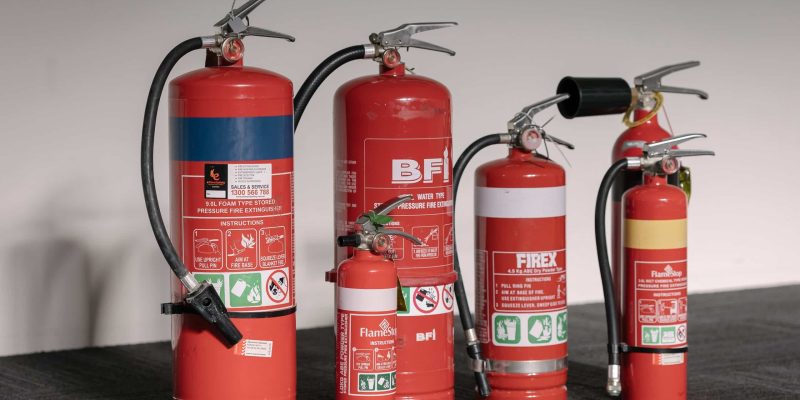
Walk into any building in Australia and you will see a fire extinguisher hanging on the wall. But ask anyone which type it is, or if it’s even the correct one, and they’ll have no idea.
That red cylinder could be your most valuable asset in an emergency situation or things could get dramatically worse if you pick up the wrong one.
Fire extinguishers are not catch-alls. Different fires, different approaches. In some instances, using the wrong extinguisher can actually spread the flames or result in dangerous reactions.
Why Fire Extinguisher Types Actually Matter
Think of it this way: you would not use a garden hose on an electrical fire. The same rule applies to all types of fire extinguishers.
Fires are classified in terms of what is burning, and for each class a particular extinguishing agent is required.
Water on burning cooking oil can cause an explosion. CO₂ extinguishers are ineffective on metal fires. The classifications are not bureaucratic; they are based on real chemistry which determines whether you will put out a fire or feed it.
In Australian workplaces, having the wrong fire extinguisher is both dangerous and a compliance issue. Building managers can face severe penalties for non-compliance, and using the wrong type of extinguisher can increase rather than decrease fire risk.
The Fire Classes You Need to Actually Understand
Let’s cover what you’re really fighting against before getting into extinguishers themselves. In Australia, fires are mainly split into six classes and this is how each one behaves:
- Class A: Ordinary combustibles such as wood, paper, fabric, and most plastics. Your typical office or home fires.
- Class B: Flammable liquids – petrol, oil, paint, solvents. They spread fast and water won’t stop them.
- Class C: Flammable gases like LPG, natural gas or acetylene. Particularly dangerous because the gas source needs shutting off.
- Class D: Combustible metals such as magnesium, aluminium powder or sodium. These burn at extremely high temperatures.
- Class E: Electrical equipment and live electrical currents. The extinguishing agent must be non-conductive.
- Class F: Cooking oils and fats, typically in commercial kitchens. These burn at very high temperatures with unique chemical properties.
The majority of fires that you are likely to encounter fall within Classes A, B, and E. However, a good understanding of all six classes will enable you to make better decisions on which extinguisher should be placed where.
Types of Fire Extinguishers Australia Actually Uses
Now that you know what burns how, let’s look at what puts it out. Here are the main types of fire extinguishers you’ll find across Australian homes and businesses.
Water and Foam Extinguishers
Water extinguishers are the simplest type, and they’re brilliant for Class A fires. They cool the burning material below its ignition point.
Foam extinguishers work in much the same way but create a blanket to smother the fire while also cooling it. Effective on Class A and Class B fires, they are more useful than water units.
The big limitation? Never use these on electrical fires or burning liquids. Water conducts electricity, and water on burning oil spreads the fire rather than extinguishing it.
Dry Chemical Powder Extinguishers (ABE)
These are probably what you’ve seen most often. The ABE powder extinguisher is the closest thing Australia has to a universal fire extinguisher, handling Classes A, B and E.
The powder interrupts the chemical reaction of the fire. It’s not the cleanest option (expect powder coating everything nearby), but it’s highly effective across multiple fire types. This makes ABE extinguishers popular in workshops, warehouses and vehicles.
One thing though—whilst they’re rated for Class E fires, turn off the electrical source if possible. And they’re not suitable for Class F cooking fires or Class D metal fires.
CO₂ Extinguishers
Carbon dioxide extinguishers are designed for Class E electrical fires, though they also work on Class B liquid fires. They don’t leave any residue, making them ideal for protecting sensitive electrical equipment like servers and computers.
CO₂ extinguishers work by displacing oxygen around the fire, thereby suffocating it. The downside is that they do not cool the material much, and hence fires can easily reignite.
Since they also work by displacing oxygen, using them within small spaces or areas with poor ventilation poses a great danger to the person operating the extinguisher.
Wet Chemical Extinguishers
These specialised units are designed for Class F fires—the cooking oil and fat fires common in commercial kitchens. The wet chemical creates a soapy foam that cools the oil and creates a barrier preventing re-ignition.
Which Fire Extinguisher Do I Need? The Practical Answer
That’s the theory. Here’s what you really need to know: which one should you actually buy or install? The answer depends entirely on what is present within your space.
More than just being useless, using the wrong extinguisher can often propagate a bigger mess. You need to match the type of extinguisher with fire risks in your environment.
A quick guide for easy reference:
| Location | Recommended Extinguisher Type | Why |
| Typical Home | ABE dry chemical powder (2.5 kg-4.5 kg) | Covers most likely scenarios—burning furniture, flammable liquids, and electrical fires |
| Offices | ABE extinguishers and CO₂ near IT equipment | General coverage plus residue-free protection for electronics |
| Workshops & Garages | ABE extinguishers | Handles flammable liquids, electrical tools, and combustible materials |
| Commercial Kitchens | Wet chemical (near cooking equipment) + ABE or CO₂ (other areas) | Mandatory for cooking oil fires, with backup for other fire types |
| Industrial Facilities | Varies—requires professional assessment | Depends on specific materials, processes, and fire risks |
In most home scenarios, a dry chemical powder extinguisher ABE will suffice. If you are looking to purchase the appropriate fire extinguisher for your property, Integral Fire Protection carries a range of compliant units suited to Australian homes and businesses.
Offices should have general coverage from ABE extinguishers with CO₂ units placed near IT equipment so as not to leave residue damage. Workshops need ABE extinguishers near exits since they cover more than one fire risk in the same space.
The law requires a wet chemical extinguisher must be placed near the cooking appliances in commercial kitchens. An ABE or CO₂ can be installed elsewhere within the same property. Industrial sites shall have qualified assessors determine requirements based on particular materials and processes.
How Many Fire Extinguishers Do You Actually Need?
Australian Standards specify minimum requirements, but here’s the simplified version: anyone in the building should be able to reach an extinguisher within 15 metres of travel distance.
- The size matters too: Larger spaces or areas with higher fire risks require either larger fire extinguisher units or a greater number of them.
- Small offices or homes: A couple of 2.5kg ABE units will usually suffice.
- Warehouses or large commercial spaces: Multiple 9 kg extinguishers strategically placed
Australian Standard AS 2444 specifies a maximum travel distance of fifteen (15) metres from any point on the floor to the nearest extinguisher for general Class A fire risks.
This regulation is based upon an assessment of the speed with which persons may need to access firefighting equipment in emergencies, rather than being arbitrary or simply convenient.
Here’s what people miss – you need different extinguisher types based on fire risks in different areas. Your office might only need ABE units, but your electrical room needs CO₂, and your kitchen needs wet chemicals.
Ensure you have the right type of extinguisher for each area’s specific fire risks, not just the same type scattered throughout the entire premises.
Reading the Label (Because It Actually Tells You Important Stuff)
All fire extinguishers sold in Australia must be clearly labelled with the classes of fire they are rated for. Look for the letters A, B, C, D, E or F. Sometimes these are shown with pictograms.
The label will also state its capacity and discharge time. Most portable units have a discharge time of only between 10 and 20 seconds! You must use them efficiently – that is not much time when you’re standing in front of flames panicking.
Check the inspection tag too. According to Australian Standards, fire extinguishers need servicing every six months. If the tag shows an expired service date, that extinguisher might not work when you need it.
Common Mistakes People Make
This is where most people get it wrong. They buy a fire extinguisher, hang it on the wall, and forget about it for years. That will not help when an emergency occurs.
Wrong locations! Mounting them above stoves or near any fire hazard means that you may not be able to safely reach them in case of a fire breaking out. Place them along escape routes instead.
And probably the biggest mistake? Not knowing how to actually use the thing. The PASS technique (Pull, Aim, Squeeze, Sweep) sounds simple enough – but most people fumble it in an emergency situation.
Get real training from fire safety professionals such as those at Integral Fire Protection.
Maintaining Your Fire Extinguishers
This is not optional. Australian Standards mandate a set frequency of maintenance and testing.
Extinguishers require professional servicing every six months, accompanied by either more intensive testing or refilling five years thereafter.
Carry out monthly visual inspections between services, checking for:
- Any physical damage to the cylinder or hose.
- Pressure gauge reading within the green zone.
- No obstructions to access.
- The safety seals remain intact.
- Labels and instructions are both legible.
If an extinguisher has been used, even partially, then it needs immediate professional servicing or replacement. Do not attempt to recharge it yourself.
Fire Safety Goes Beyond Just Having Extinguishers
Look, having the right fire extinguishers is important. But they’re just one part of fire safety. You also need working smoke alarms, clear evacuation plans, and proper training for occupants.
Integral Fire Protection offers comprehensive fire and safety equipment across Australia, including fire extinguisher supply, installation, testing, and maintenance.
They can assess your specific needs, ensure you’re meeting all regulatory requirements, and provide training so your team knows what to actually do with those red cylinders on the wall.
They also handle fire blankets, smoke alarms, emergency lighting, and other fire safety equipment that works alongside extinguishers to keep people safe.
Getting It Right Matters
Fire extinguishers seem straightforward until you really look into them. Then you realise there’s genuine complexity in choosing the right type, placing them correctly, and maintaining them properly.
Getting it right genuinely matters. The wrong extinguisher can turn a small incident into a major disaster. The right extinguisher, properly maintained and correctly used, can stop a fire in seconds before it spreads.
They offer comprehensive fire and safety equipment supply, professional installation, and ongoing maintenance services to ensure your property stays compliant and protected.
You can also connect with them on Facebook for fire safety tips and updates. Don’t guess about something this important.
Because when smoke starts filling the room, there’s no time to read labels or second-guess which cylinder to grab.
For more information, please contact us by clicking here, calling us on our land line (08 9467 7319) or sending us an email at info@integralfireprotection.com.au