
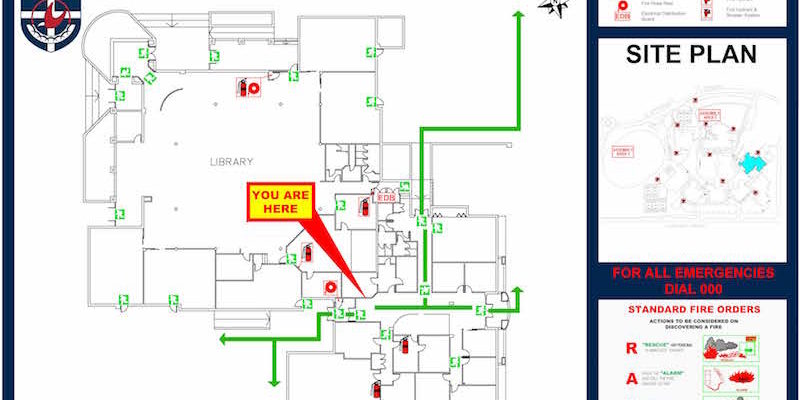
When you’re walking through a building in the Perth CBD or a warehouse in Malaga, you probably don’t give the evacuation diagrams a second glance. Most people don’t, until they have to.
But when the power cuts, the alarms are triggered and the air starts to taste like plastic and smoke. You aren’t looking for a pretty looking piece of artwork, you’re looking for a lifeline.
Many business owners treat evacuation diagrams as an afterthought. They get some building plans printed and stick them up on the wall with some blue tack, maybe even a frame. That’s a dangerous way to handle safety.
There is a specific way these diagrams need to be located, how high they sit and which way they face. You not only risk failing an audit, but the people who work for you.
The Geography of Survival: Strategic Placement
An evacuation diagram is useless if it isn’t positioned along the path of travel. You shouldn’t have to go on a scavenger hunt to find the exit map while the building is being cleared during an emergency.
According to Australian Standard AS 3745-2010, diagrams need to be placed where people are most likely to see them. This usually means near the main entry points to each floor, in lift lobbies, and at the entrance to all emergency exit stairs.
You should also consider areas that your staff spend time in such as staff break rooms and communal kitchens.
You can’t just hang up signs and hope for the best. Putting up too many signs and cluttering the space is also not good. This can cause safety blindness where people stop seeing information because it’s just more visual noise. A diagram must be permanently fixed and completely unobstructed.
Cracking the Code on AS 3745 Mounting Heights
One area that is a common issue in safety audits is the physical height of the diagram. The standard is quite specific here, and for good reason.
The “Zone of Sight” doesn’t just refer to the average height of a person. Its also about accessibility. AS 3745 dictates that the diagrams should be mounted at a height between 1200mm and 1600mm from the finished floor level.
This is the perfect spot for the human eye to see it. It makes sure that someone standing can read it and someone who is in a wheelchair can also read it without having to pull themselves up or strain themselves to see.
If you’ve got a facility in Fremantle or Osborne Park with high traffic public access, this isn’t just a suggestion, it’s a critical part of making your building inclusive and compliant.
It’s worth mentioning that the 1600mm limit is measured to the top of the diagram. We’ve seen plenty of DIY installations where the middle of the map is at eye level for a tall person, making the top section virtually invisible to a shorter person or a child. Precision matters.
Technical Accuracy: What Your Diagram Must Include
For legal compliance in WA, a diagram isn’t just a floor plan. AS 3745 divides the requirements into Minimum Elements and Optional Elements. And if you don’t include the minimums, your diagram is legally void.
Here is a list of some points that are non-negotiable.
The ‘You Are Here’ point: This must be extremely obvious and in a high contrast coloured icon, normally red.
Designated exit paths: You must show the fastest route to the exit (primary exit) and the back up exit (secondary exit).
Fire fighting equipment: Every fire extinguisher, hose reel and fire blanket must be mapped accurately using the correct Australian Standard symbols. Your equipment must be exactly where it should be.
Manual call points (MCPs): The locations of those “break glass” alarms. This is important to trigger fire alarms when needed.
Assembly point: This should be a clear illustrated area for people to meet during an evacuation.
The “You Are Here” Trap
Failure of orientation is a common problem we have seen among Perth businesses.
If you are standing in a corridor facing North and you look at the evacuation diagram on the wall. If the “Up” direction on that map points toward the South, your brain has to do a 180 degree mental flip to figure out which way to turn.
This is generally fine during a normal situation but during an emergency in a smoke filled corridor, this is a safety hazard.
This is what being “oriented to the floor.” Every single diagram must be rotated to match the viewer’s perspective. If you are looking at the map, the hallway to your left in real life must be on the left side of the diagram.
This means that you cannot print 50 identical diagrams and paste them up around your business. Each diagram must be its own specific version of the map that is adjusted for its exact spot.
The Role of the Emergency Planning Committee (EPC)
In larger WA facilities, the placement of these diagrams isn’t just up to the facility manager—it’s a decision that should involve the Emergency Planning Committee (EPC). The EPC is responsible for developing the emergency plan and ensuring it is implemented.
The reality is that your EPC should be reviewing these diagrams at least annually. Why? Because buildings change. Maybe you’ve partitioned off a new office space in your West Perth firm, or perhaps you’ve added new racking in your Canning Vale warehouse that obscures the original exit route. A diagram that was accurate in 2022 might be a liability in 2026.
The Assembly Point
Your evacuation diagram shows people how to get out of the building, but once they are outside does it explain where to go?
One of the most overlooked parts of the evacuation process the assembly point. Using any random car park is not sufficient. Your assembly area needs to be far enough away that people won’t be hit by falling glass or radiant heat and it must be out of the way for any emergency vehicles like ambulance or fire trucks to arrive.
Does your evacuation diagram clearly show the path to the assembly point?
The Professional Advantage
When we handle fire protection services for our clients, we take that weight off their shoulders. We don’t just print a map, we audit the site, check the mounting heights, ensure the orientation is perfect for every single wall and use the highest quality materials.
Whether you’re running a small cafe or a mining corporation, the goal is the same. Making sure everyone gets home at the end of the day.
Would you like us to conduct a quick audit of your current evacuation diagrams to see if they meet the latest AS 3745 mounting height and orientation standards?