
A lot of business owners assume that a printed floor plan taped up onto to the wall ticks the box for an evacuation diagram. It doesn’t.
There is a specific Australian Standard that governs what an evacuation diagram must include and how it must be displayed.
A hand drawn sketch one of your team members drew up in 2015 will not hold up during an audit.
If your business operates from a building that other people use including staff, clients, contractors or visitors, you almost certainly need a compliant evacuation diagram.
If you’re not sure where to start this article will explore what the standard actually requires, who is responsible for getting it done and what happens when it has been overlooked.
What Is an Evacuation Diagram?
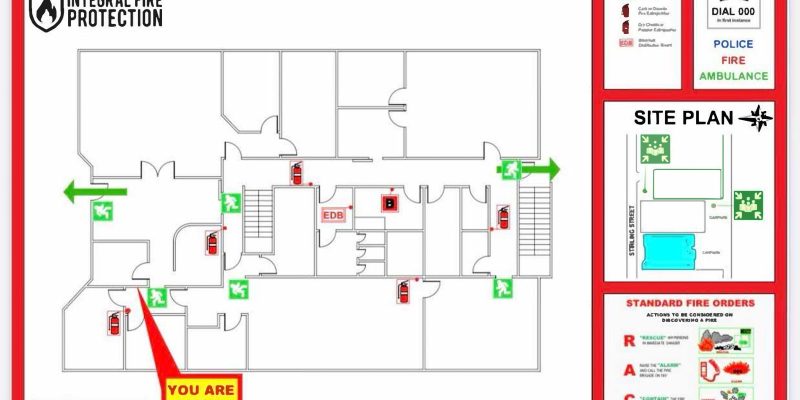
An evacuation diagram is a clearly formatted, site-specific document that shows the exact layout of a building and identifies the key information a person needs to get out safely in an emergency.
Think of it as the document you hope nobody ever needs, but that will make a critical difference if they ever do.
A compliant evacuation diagram is not just a fire exit sign with an arrow.
Under AS 3745-2010, Planning for Emergencies in Facilities, the diagram must show your current location within the building, all exits and evacuation routes, fire extinguisher and hose reel locations, first aid equipment, assembly areas and emergency contact information for the facility.
Where the diagram lives is also important. Each diagram must be mounted on the wall at a specific height in a position that is easily readable.
If your building has multiple floors, each area needs its own diagram.
Are Evacuation Diagrams a Legal Requirement in Western Australia?
For most commercial premises in Western Australia, yes evacuation diagrams are a legal requirement.
AS 3745-2010 applies to facilities where people other than the occupant use the space, which covers the vast majority of commercial, industrial, retail, healthcare, hospitality, strata and education settings.
While Australian Standards are not always automatically enforceable as standalone legislation, local fire authorities and building certifiers reference AS 3745-2010 as the accepted benchmark.
In practice if your building is audited by a fire authority or your property is assessed as part of a lease arrangement, if you do not have a current and compliant evacuation diagram, it will be flagged as a deficiency.
If you are a property manager or run a strata company, each one of your properties require its own diagram.
All diagrams must be updated with any changes to the layout or equipment.
What Happens If Your Evacuation Diagram Is Out of Date?
This is a common problem across businesses. Your evacuation diagram may have been compliant and accurate when it was first made, but if any changes to the layout of your property or the placement of equipment are made, the diagram must be updated with it.
The diagram must match the exact layout of the current premises. This is particularly relevant after a refurbishment, and any changes in equipment or how the space is used.
An outdated diagram creates two problems. The first is obvious as it gives people the wrong information in an emergency. If people in your building must evacuate they need an accurate path to follow.
The second problem is that if it surfaces during an audit or incident investigation, it suggests the facility manager or business owner is not meeting their obligations.
As a general rule an evacuation diagram should be reviewed whenever the layout of a space changes and at regular intervals regardless.
If you are not sure when yours were last updated, that is a reasonable sign they are probably due to be reviewed.
What Does a Compliant Evacuation Diagram Include?
A compliant evacuation diagram under AS 3745-2010 is a clearly drawn, representational floor plan using standardised symbols for fire equipment, exits and related features.
The “you are here” marker must also be accurate for each individual mounting point, which means a single generic diagram used across multiple positions in a building will not comply.
The diagram must also carry current emergency contact information, the date it was prepared or last revised and the name of the person or organisation responsible for it.
Colour coding is used to differentiate zones and directional arrows must be unambiguous.
Getting it right matters, which is why most Perth businesses seek the help of a fire protection company to prepare and supply their diagrams rather than attempting to produce them in house.
Evacuation Diagram Services in Perth
At Integral Fire Protection, we produce compliant evacuation diagrams and procedures for businesses across Perth and Western Australia.
Our team conducts an in depth site assessment, prepares the diagrams to the AS 3745-2010 standard and supplies them ready for mounting, including the hardware used to mount the diagrams.
We work across all building types, from single tenancy commercial offices to multi-floor strata buildings and large industrial facilities.
If you manage multiple properties we can easily coordinate across all of your locations. We also offer a free site audit and quote, so if you are unsure about what is needed for your specific location we can take a look for you and make sure you are prepared and compliant.
Get Your Perth Evacuation Diagrams Sorted Today
If your evacuation diagrams are overdue for a review, out of date or have not been done at all, now is a good time to get on top of it.
Contact the team at Integral Fire Protection for a free consultation and we will make sure your premises is properly covered.