
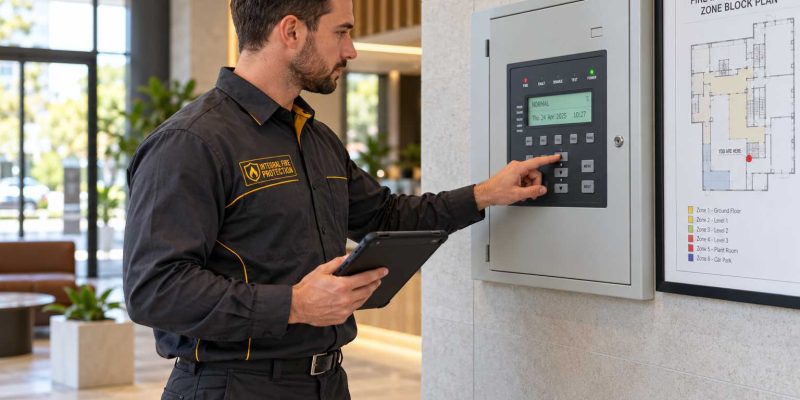
When a fire alarm system hasn’t been serviced, the panel on the wall looks exactly the same as one that has. That’s the problem.
A fire alarm system is only as reliable as its last service. Missing one could put your staff and your building at risk.
Fire alarm servicing in Perth is a legal requirement for any commercial, industrial, strata or care facility building with a fire detection and alarm system installed.
Under AS 1851-2012, these systems must be inspected, tested and maintained on a defined schedule by qualified technicians.
What Is a Fire Alarm System and What Does It Include?
Before getting into servicing requirements, it helps to be clear on what a fire alarm system covers.
A fire detection and alarm system in a commercial building typically includes smoke detectors and heat detectors positioned throughout the building, manual call points on each floor and at exits, a fire indicator panel. A fire indicator panel, also known as FIP or FDCIE, monitors every device in the system and displays any faults or activations.
The system should also include an occupant warning system that sounds the alarm throughout the building when the panel goes into alarm and in larger buildings an Emergency Warning and Intercommunication System, known as EWIS, which allows floor wardens to communicate during an evacuation.
Each of these components has its own testing and maintenance requirements under AS 1851-2012.
A service that only looks at the panel without testing the detectors or that tests a sample of devices rather than the full system, is not a compliant service.
How Often Does a Fire Alarm System Need to Be Serviced in Perth?
Under AS 1851-2012, fire detection and alarm systems are subject to routine service at monthly, six monthly and annual intervals.
The frequency and scope of each visit depends on the system type and the components installed.
Monthly checks are generally the responsibility of the building owner or facility manager rather than a contracted technician. They usually involve a visual check of the panel to confirm it is showing a normal status with no faults, that the battery and mains indicators are reading correctly and that the panel has not been isolated or put into test mode and left there.
These checks are simple but important because a fault that appears on the panel between technician visits needs to be noticed and acted on rather than just ignored until the next service.
Six monthly servicing is where a qualified fire protection technician takes over. At the six monthly visit the technician will test smoke and heat detectors to confirm they are responding correctly.
They will also inspect and test manual call points, check the fire indicator panel for faults and battery condition, test the occupant warning system and confirm that the alarm is audible throughout the building and also inspect all cabling and connections for signs of damage or deterioration. The results of every test must be recorded.
The annual service goes into even more detail. At twelve months every detector and call point in the system is tested individually rather than by sample. The full alarm sequence is checked right from device activation through to panel response and occupant warning.
EWIS systems get a full functional test including the warden intercommunication handsets. Battery backup is tested to confirm it will work in a power failure. Any devices that fail or don’t work up to standards are documented and replaced.
What Happens If a Fire Alarm System Is Not Serviced?
The honest answer is that you often won’t know there is a problem until you need it.
Smoke detectors accumulate dust and debris over time. A detector that hasn’t been serviced may still trigger a response, however there can also be no visible signs that it isn’t in working order.
A detector that looks perfectly normal from the floor can be too insensitive to detect smoke reliably or so sensitive that it triggers false alarms at the slightest change in air quality.
The fire indicator panel is the brain of the system and it is also where faults tend to sit unaddressed in buildings where servicing has lapsed. A panel with an active fault on a zone or device is a panel that may not work properly when it is needed.
A qualified technician reading the panel at a service visit will identify what the fault is, what caused it and what needs to happen to clear it.
Battery backup failure is another common issue when services are missed. The backup battery in a fire indicator panel is designed to keep the fire alarm system working during a power outage.
From a compliance perspective, a fire alarm system that hasn’t been serviced is a documented deficiency. DFES inspections, insurance assessments and lease related due diligence all look at servicing records.
If there are gaps in your service history, it can add even more complications during a crisis. When your building is already dealing with a fire, the last thing you need is missing documentation that covers you with insurance.
Who Can Service a Fire Alarm System in Western Australia?
Fire alarm servicing in Perth must be carried out by a qualified technician with the relevant competency.
The technician needs to be familiar with AS 1851-2012 and AS 1670.1 which is the standard that governs the design and installation of fire detection and alarm systems. These two standards work together when it comes to assessing whether a system is performing as it was originally designed to.
Not every electrician or general maintenance contractor is qualified to service a fire alarm system.
Check your technician holds relevant fire protection qualifications and that the business holds FPAA accreditation.
What Should a Fire Alarm Service Report Include?
After every service visit the technician should provide a written report that documents what was tested, the results of each test, any faults or deficiencies identified and what was done or recommended to address them.
The report should identify which specific devices were tested and the results at the device level, not just a general pass or fail for the system as a whole.
This report is the record that protects you. An auditor, insurer or building certifier will ask to see it.
A service that was carried out but not properly documented carries no more weight than a service that never happened, because there is no evidence.
For property managers and strata companies overseeing multiple buildings, keeping track of service dates and reports across a portfolio can become an administrative burden. Integral Fire Protection clients can access their full service history, reports and upcoming service dates through the IFP Client Portal at any time, across every site in their portfolio.
Fire Alarm Servicing Across Perth and Western Australia
At Integral Fire Protection, our technicians service fire detection and alarm systems for commercial businesses, strata companies, industrial facilities, aged care providers and schools across Perth and throughout Western Australia.
Our servicing covers smoke and heat detector testing, fire indicator panel maintenance, occupant warning system testing, EWIS servicing and battery and fault testing. All carried out to AS 1851-2012 and documented with a full written report after every visit.
Our technicians are FPAA accredited and qualified across all major panel and system types.
If you are not sure when your fire alarm system was last properly serviced or you have taken on a new building and need to establish what the system’s current condition is, get in touch with the Integral Fire Protection team for a free site audit and quote.